Beneath the surface of the Baltic Sea lie more than 100,000 shipwrecks — preserved by cold, brackish water and held in extraordinary detail. Through Ocean Culture, Voice of the Ocean helps bring these hidden stories of trade, travel, war and loss back into public view.
- The Baltic’s cold, brackish waters preserve over 100,000 shipwrecks with uncanny detail, creating a photographic memory of maritime lives and losses.
- Voice of the Ocean’s Ocean Culture programme uses marine archaeology, photogrammetry and exhibitions to reveal wreck stories without disturbing fragile sites.
- Wrecks are a human archive of trade, war and everyday life, urging us to historicise the sea and learn how to listen.
A sea with a photographic memory
Champagne bottles still stacked in cargo holds. Pocket watches resting where they fell. Abandoned cabins. Silent decks. Ships preserved so clearly it can feel as if their crews have only just stepped ashore.
Beneath the Baltic Sea lie more than 100,000 such scenes: shipwrecks frozen in time, each one holding a fragment of human history.
The Baltic has always been more than water. It is the maritime crossroads of northern Europe — a sea shaped by empires, trading leagues, naval rivalries, migration, conflict and exchange. For centuries, people crossed it to move goods, ideas, soldiers, families, fortunes and hopes.
Some never arrived.
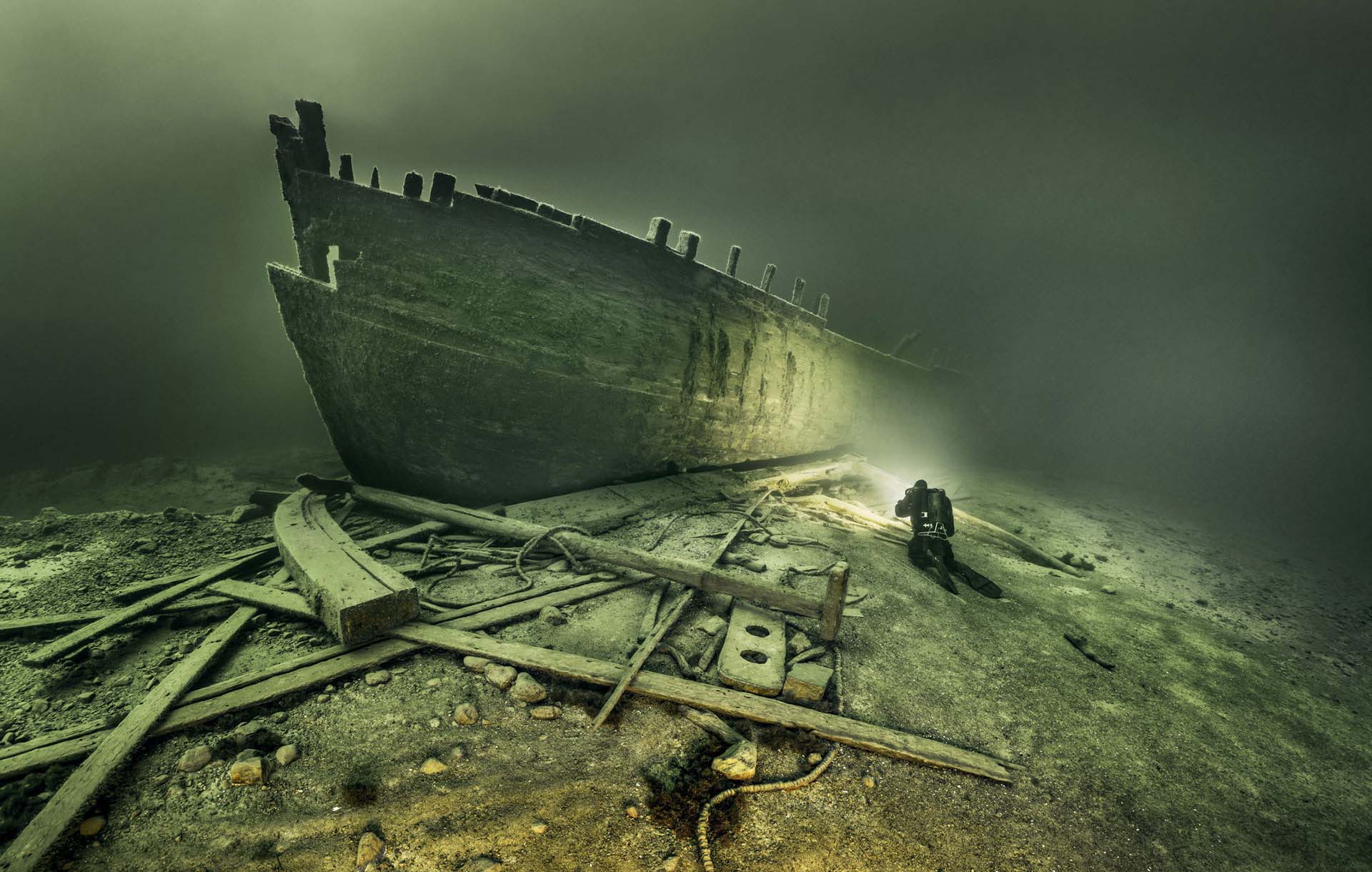
When wooden vessels sink into the Baltic, they enter a rare kind of twilight. History and decay are both held at bay. Warships, merchant vessels and trading ships can remain on the seabed in remarkable condition, their cargoes and personal belongings undisturbed for generations.
It is a strange effect. Ships separated by decades, even centuries, can exist in almost the same state of preservation. The reason is ecological. The Baltic’s cold, brackish waters deter shipworm, allowing wooden wrecks to survive with extraordinary clarity.
This is the oceanic equivalent of a photographic memory.
This is the sea that never forgets.
Ghost ships beneath the surface
Through its Ocean Culture programme, Voice of the Ocean supports work that brings these hidden stories into public view.
One striking example is Ghost Ships, an immersive exhibition at Sweden’s National Maritime Museum in Stockholm. Based on the underwater photography of Jonas Dahm, the exhibition invites visitors to descend into the Baltic’s dark green depths and encounter wrecks from across the centuries. Combining film with large illuminated lightboxes, Ghost Ships transforms marine archaeology into an atmospheric visual experience.
The wrecks are beautiful, but not simply beautiful.
They are also poignant. Many of these vessels were lost suddenly. Lives were interrupted. Journeys ended without warning. Beneath the surface, the Baltic holds more than ships. It holds traces of trade, travel, war, work, fear, skill, ambition and loss.
To look at these wrecks is to understand the sea not as an empty space between countries, but as a human landscape.
A place where history happened.
From seabed to society
Marine archaeology often begins in darkness: on the seabed, in cold water, with cameras, lights, divers, remotely operated vehicles and patient technical work.
But the story cannot end there.
If discoveries remain hidden beneath the waves, they risk slipping from public consciousness. VOTO’s Ocean Culture work exists to close that distance — bringing underwater heritage into museums, books, exhibitions and public conversations.
That matters because the ocean is often treated as a natural space alone. A place of ecosystems, currents, storms and species. It is all of those things. But it is also a cultural space. A route. A memory. A witness.
For thousands of years, the sea has connected people more than it has divided them. Ships carried trade, language, belief, power, food, technology and conflict across its surface. When some of those ships sank, the sea kept their stories.
Ocean Culture helps bring them back.
Not by stripping wrecks from the seabed, but by translating them into experiences people can see, feel and understand.
The Hansa: a trauma beneath the waves
Some wrecks are ancient. Others remain painfully close.
In the dark early hours of 24 November 1944, during the chaotic endgame of the Second World War, the Swedish passenger ferry S/S Hansa was struck by a Soviet torpedo off the coast of Gotland.
A massive explosion tore through the ship. It sank within a minute.
Of the 86 people on board, only two survived. One survived by chance, asleep in the radio cabin as it was flung clear by the blast. A clock from that cabin later washed ashore in the Stockholm archipelago. Its hands had stopped at 5:57am — the exact time the ship went down.
Hansa had been on a scheduled passenger voyage within neutral Sweden. But in the fog and fear of wartime naval conflict, neutrality offered no guarantee of safety.
“The disaster sent shockwaves across Sweden.
On Gotland especially, it was – and still is –
a collective trauma.”
The wreck still lies around 100 metres down on the Baltic seabed.
It was never seriously considered for salvage. Instead, it would remain where it fell, protected in situ by the same cold, brackish waters that preserve so much of the Baltic’s underwater history.
But remaining in place does not have to mean remaining unseen.
A digital restoration
At Sweden’s National Maritime Museum in Stockholm, a VOTO-supported exhibition tells the story of the sinking of Hansa.
Sweden’s most famous wreck is the 17th-century warship Vasa, raised in the 1960s and now housed in its own museum. Hansa is different. It remains on the seabed, fragile, intact and unreachable to most people.
So instead of raising the ship physically, VOTO has helped bring it to the surface in another way.
As Martin Widman, a project manager for Ocean Culture, explains:
“The technique we used was photogrammetry. We took something like 10,000 images, centimetre by centimetre. That allows you to build a full 3D model.”
The result is one of the exhibition’s defining features: a detailed digital reconstruction of the wreck site. Visitors can move around the virtual seabed, navigating the remains of the vessel as it lies today — fractured by the blast, but otherwise eerily intact.
The technology allows audiences to encounter the wreck without disturbing it.
Instead of bringing the ship to the public, it brings the public to the ship.
Into the light
The Hansa exhibition first opened at the Museum of Gotland before moving to Stockholm’s National Maritime Museum.
Its strength lies in restraint. It does not turn tragedy into spectacle. It restores individuality to a wartime disaster and places the sinking in a wider context, showing that even neutral Sweden could not remain unscarred by the Second World War.
The exhibition is also a clear expression of Ocean Culture’s wider purpose: what Martin Widman has described as “historicising the ocean”.
That phrase matters.
To historicise the ocean is to reconnect people with the sea as a human space — not only a surface to cross or a resource to use, but a place where lives unfolded, societies formed, cultures spread and tragedies were absorbed.
The Hansa exhibition does this with unusual sensitivity. It does not raise the wreck from the deep. It raises the stories.
The clock stopped at 5:57am. The wreck stayed below. But through photography, testimony, archival material and digital reconstruction, the people and the moment are brought back into public recognition.
Why memory matters
The ocean is often described through what it gives us: oxygen, food, climate regulation, biodiversity, transport, energy and beauty.
But it also holds memory.
The Baltic seabed is an archive of northern Europe: trade routes, wartime losses, merchant life, naval power, everyday objects, sudden endings and forgotten journeys. Some wrecks speak of empires and conflict. Others speak of ordinary people moving through an uncertain world.
Without careful work, these stories remain invisible.
And when ocean history is invisible, the sea itself can begin to feel peripheral — a gap between places rather than a place in its own right.
Ocean Culture works against that forgetting.
Through marine archaeology, exhibitions and storytelling, Voice of the Ocean helps bring submerged history into shared awareness. It shows that the ocean is not separate from human life. It has always been part of it.
The sea remembers.
Our task is to learn how to listen.