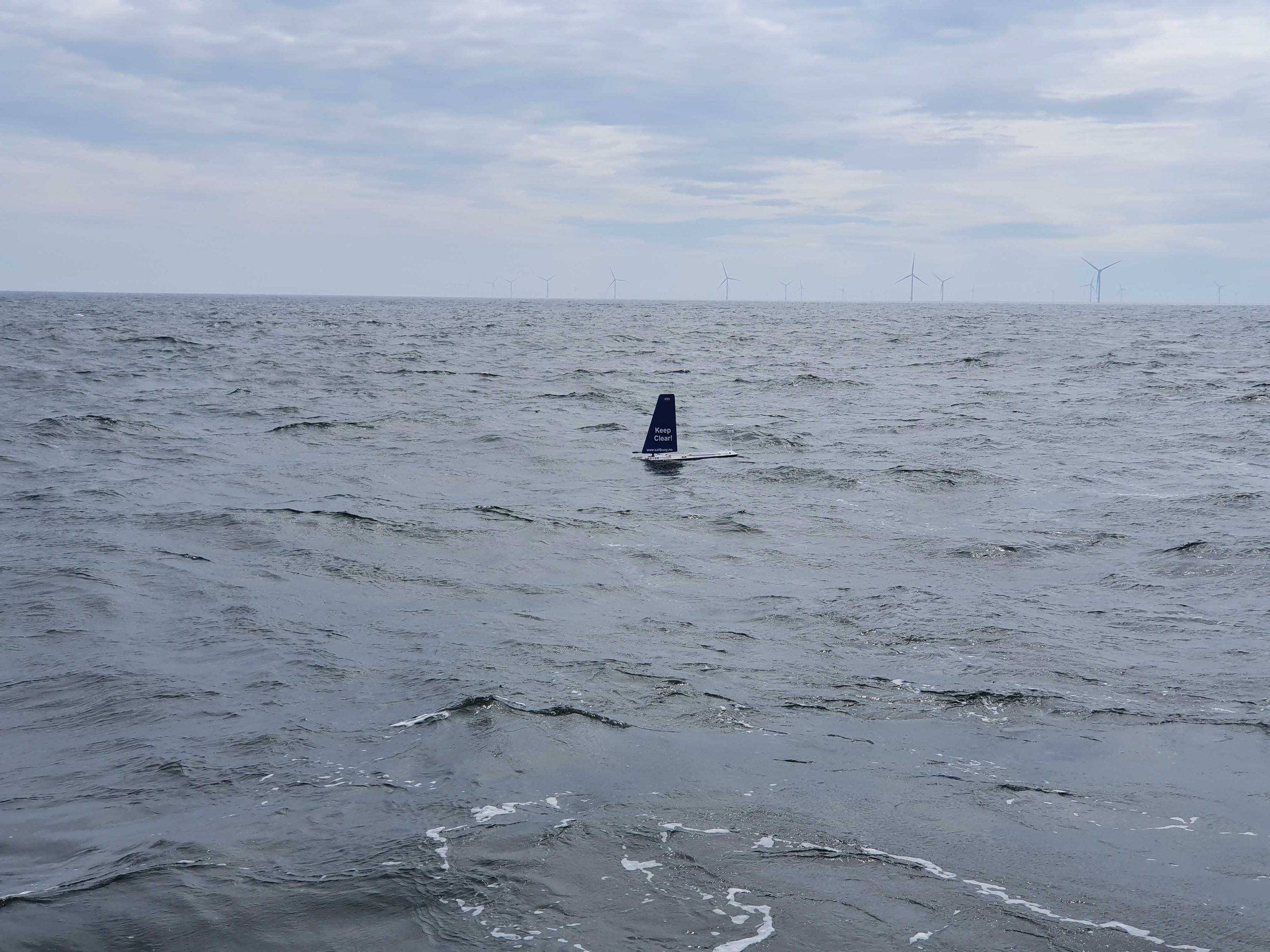
The project was supported by VOTO by deploying a sailbuoy outside the Kriegers flak Offshore Wind Farm (OWF) in 2024. The sailbuoy functioned well during the campaign and we got data as expected. We compare observations from the sailbuoy with observations from the nearby FINO2 oceanographic and meteorological platform.
Observations show that sailbuoy provided essentially good values. We see a drift in surface water salinity at the end of the campaign, and the wind speed has a large scatter. The latter implies that we are hesitant to say that we can detect the wind wake from the OWF’s at Kriegers flak and any significant impact on e.g. ocean stratification or mixing.
We also compared observations with results from a meteorological model dataset (NORA3 from Norwegian Meteorological Institute), and from an ocean model available at the marine Copernicus web site. Observations compare quite well, but also show a large natural variability in both ocean and atmospheric fields that hampers a detailed analysis of the atmospheric and oceanic response from the OWF.